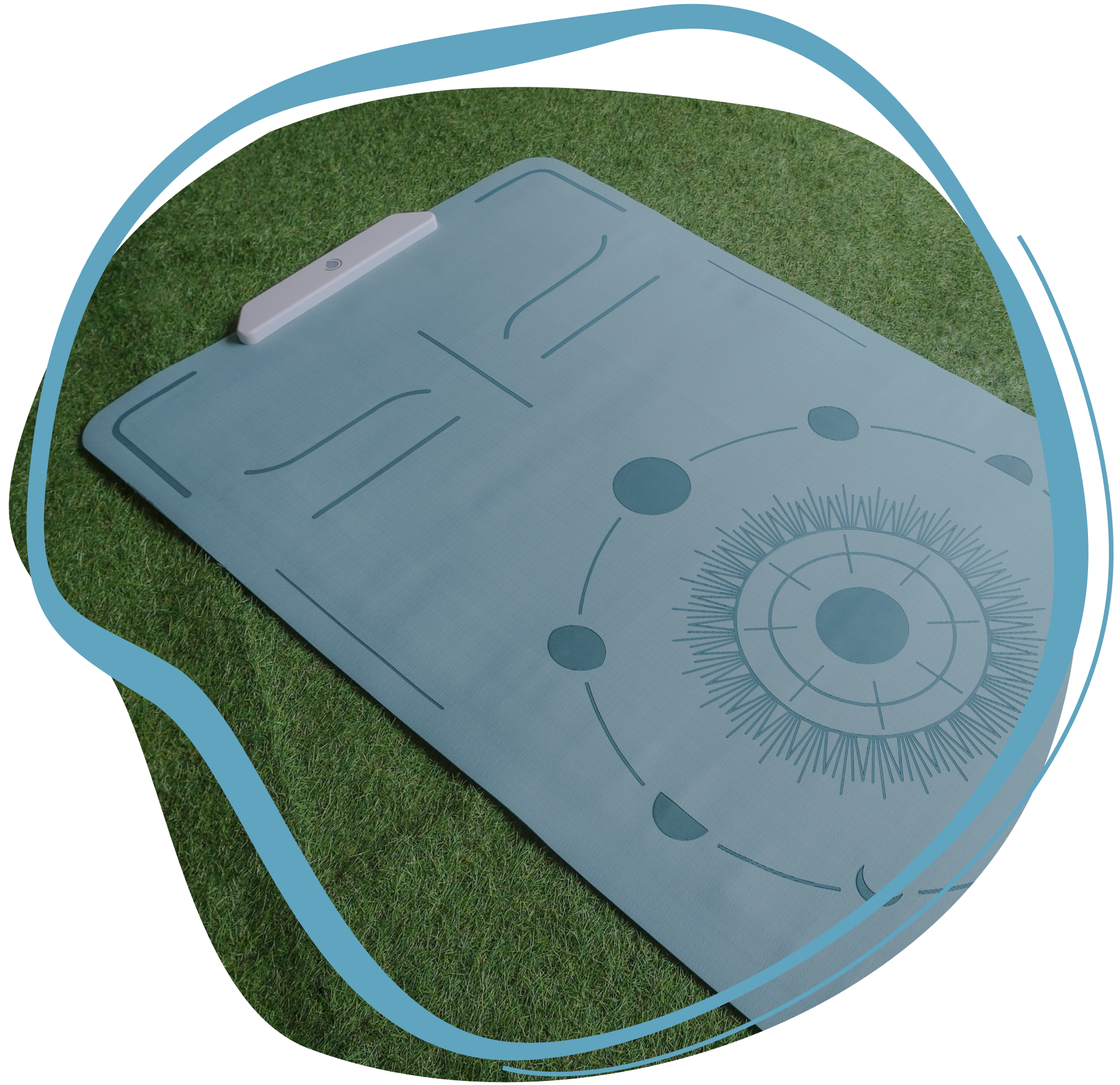
We are developing an AIoT yoga mat called yoctoMat.
…And when I say that, people usually think:
“Oh, so you’re a yoga mat company.”
But it’s actually a little different.
What we are really trying to do is:
Understand the relationship between the human body and gravity through data.
Let me talk about gravity for a moment
After spending years observing yoga, I’ve realized something:
People interact with gravity very differently.
Standing.
Sitting.
Balancing.
Holding posture.
Every movement on a mat eventually comes down to one thing:
How the body maintains its center of gravity against gravity itself.
Yoga instructors observe this intuitively.
They see it.
Feel it.
And translate it into words.
But inside that “intuition” is an incredible amount of information.
For a long time, I kept wondering:
“Can we extract that information as data?”
That question eventually became yoctoMat.
It started with more than 1,200 sensors
yoctoMat contains more than 1,200 pressure sensors.
Compared to the human body, it’s still primitive.
But it turned out to be enough to draw what I like to call:
“A map of gravity.”
When someone steps onto the mat, we can visualize:
where body weight is applied
where the center of gravity shifts
how balance changes between left and right
When I explain this to customers, it tends to click immediately.
Probably because gravity is something every human being experiences every single day.
How it actually works
This year, we’ve been seriously expanding our AI analysis efforts around this data.
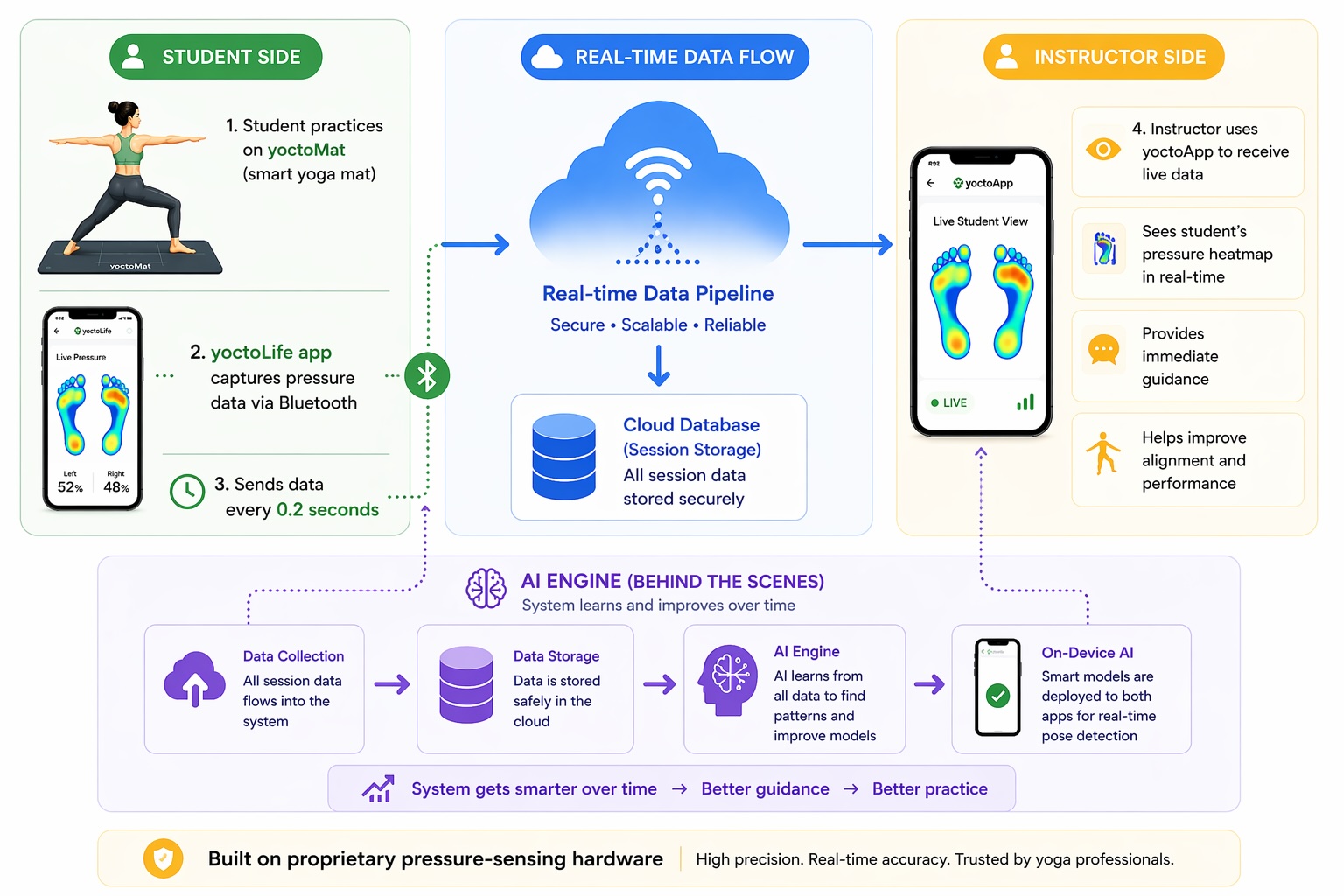
The overall structure is actually quite simple.
A student practices on yoctoMat.
Data is transferred via Bluetooth.
It’s accumulated in the cloud.
The AI Engine learns from it.
And real-time feedback is returned to the instructor.
There’s one sentence in the diagram that captures everything:
System gets smarter over time → Better guidance → Better practice
The way I imagine it is this:
The mat slowly begins to understand the “sense of gravity” that instructors have spent years building inside their bodies.
Eventually, it becomes a true partner for instructors -
helping create deeper learning experiences for students.
The difference between “seeing” and “feeling” gravity
Apple Watch “wears” the body.
Camera AI “sees” the body.
yoctoMat “feels” gravity.
And I think that difference is bigger than it first appears.
Accelerometers detect movement.
Cameras estimate posture.
But pressure sensors directly capture:
how the human body responds to gravity.
To me, that’s a completely different category of data.
Not a replacement for existing sensors - but an expansion of how we understand the body itself.
The world is moving toward Physical AI
Recently, terms like “Physical AI” and “Embodied AI” have started appearing everywhere.
AI is moving beyond screens and into the real world.
Google is already researching ways to analyze wearable sensor data using AI to better understand human physical states:
https://pharmaphorum.com/news/google-wearable-ai-can-learn-language-our-bodies
Research around Embodied AI and Physical AI is also accelerating globally:
https://www.techrxiv.org/doi/pdf/10.36227/techrxiv.176238257.73914361/v1?download=true
There are also ongoing studies involving pressure-sensing mats and real-time AI analysis:
https://www.ijcai.org/proceedings/2024/0796.pdf
And AI-driven gait analysis and frailty prevention are becoming increasingly important:
https://arxiv.org/abs/2508.03436
Honestly, we never intentionally called ourselves a “Physical AI” company.
But at some point, we realized we had already stepped into that space.
Another field the mat unexpectedly opened
Recently, we’ve also seen growing demand from fitness gyms and Pilates studios.
“We want center-of-gravity data inside our app.”
“We want to record posture changes during lessons.”
We’re beginning to support those needs like a sensor-data plugin layer.
What surprised us even more was the senior-care field.
Simply sitting, standing, and walking on the mat can already quantify aspects of physical function.
And once AI analysis enters the picture, the possibilities expand even further.
We’re also developing features related to fall-risk visualization and frailty prevention.
Personally, I think this is becoming a very interesting direction.
The world of gravity didn’t stop at yoga studios.
A quick update, or maybe just a reflection
We started as “a yoga mat company.”
But what we’re doing now is gradually moving into the space where:
body data and AI intersect.
We’re still very early.
Far from complete.
But the company that started by trying to “visualize gravity” has somehow made it this far.
I’d like to keep sharing that process little by little.
Body data.
AIoT.
Fitness × AI.
Physical AI.
If any of these areas resonate with you,
I’d love to connect and explore new possibilities together.
It feels like the story that started with a yoga mat is only getting started.