(日本語で読む)
The Hidden Injuries Behind Silent Dropout
“Yoga is safe. Gentle. Anyone can do it.”
That is the image many people – including yoga teachers and studio owners – still have.
But when you look carefully at what recent studies from around the world are telling us,
a slightly different picture starts to appear.
Injury itself is surprisingly common,
yet we almost never hear people say:
“I quit yoga because I got injured.”
What does this gap mean?
And where is the real risk for studios and instructors?
In this article I’ve brought together global research and Japanese data,
and tried to summarise – as simply as possible – how yoga injuries are connected to dropout and silent disengagement.

(This image is a conceptual illustration created for this article.)
1. Yoga injuries are far more common than most people think
Let’s start with the facts.
When we pull together reliable studies from Japan and overseas,
injuries and pain are not rare events among yoga practitioners.
About 1 in 10 yoga practitioners experience a new pain in a given year
About 1 in 5 report a worsening of pre-existing pain
In a Japanese survey of 2,508 participants, 27–30% reported some kind of unwanted symptom after class
In another survey, 67.4% of yoga instructors said they had injured themselves through yoga
In the US, there were 29,590 yoga-related ER visits over 14 years
For people 65 and older, the injury risk was around six times higher than in younger age groups
Severe accidents are still relatively rare.
But even so-called “minor” injuries can easily add up and become a barrier to long-term practice.
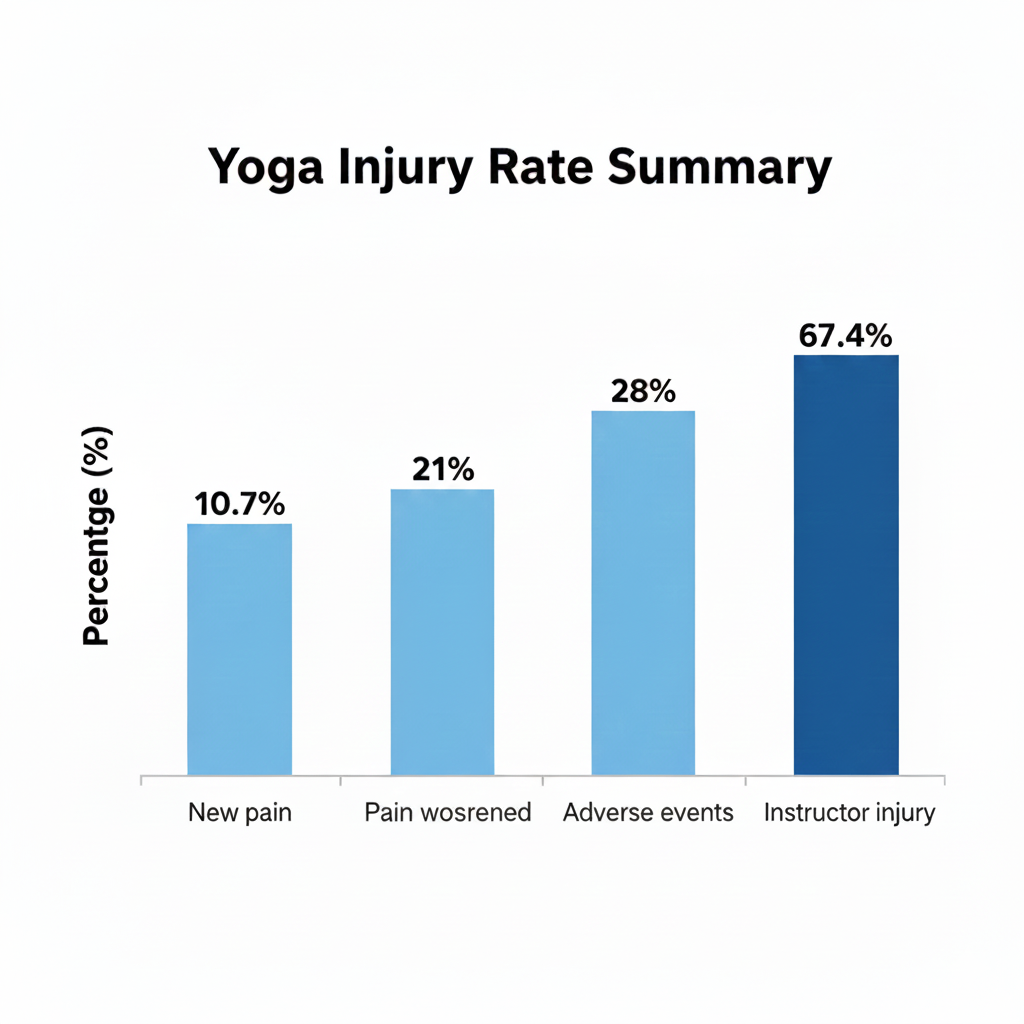
This graph combines data from multiple Japanese and international studies.
It shows that new pain (10.7%), worsening pain (21%), post-class adverse events (around 28%), and injuries among instructors themselves (67.4%) are all more common than people assume.
Note: These numbers are within the yoga-practicing population, not “per general population”. Once you include minor and moderate symptoms, yoga-related aches and pains are much more frequent than many believe.
2. The real cause of injury: “invisible misalignment”
Most yoga injuries don’t come from dramatic accidents.
They come from small misalignments and habits that accumulate over time.
For example:
Uneven weight-bearing through the hands and shoulders in Downward Dog
Repeated stress at the hamstring attachment in forward bends
Excessive lumbar extension in backbends
Knee twist during deep hip-opening poses
Manual adjustments that unintentionally push a joint past its safe range
All of these are hard to perceive in the moment – both for the practitioner and, often, for the instructor.
In other words:
The true face of many yoga injuries is “load you can’t see and don’t notice.”

(This image is a conceptual illustration created for this article.)
3. Why injuries rarely appear as “reasons for quitting”
One large survey found that fewer than 1% of people said:
“I stopped yoga because of an injury.”
At first glance that sounds like injuries are not an important issue.
In reality, it mostly means we are not hearing the full story.
Why injuries almost never show up in dropout statistics
They’re treated as “minor”
A bit of pain, some discomfort – it’s easy to shrug off and move on.
About 60% never tell their instructor about the injury
Shame, self-blame, not wanting to bother the teacher – the reasons vary.
People reframe the reason
It’s easier to say “I’m too busy these days” or “It just wasn’t for me”
than to say “I hurt myself in that class”.
35% of instructors don’t know whether their students are getting injured
Because injuries are not reported, they never appear in studio-level data.
Put simply:
Yoga injuries are structurally invisible.
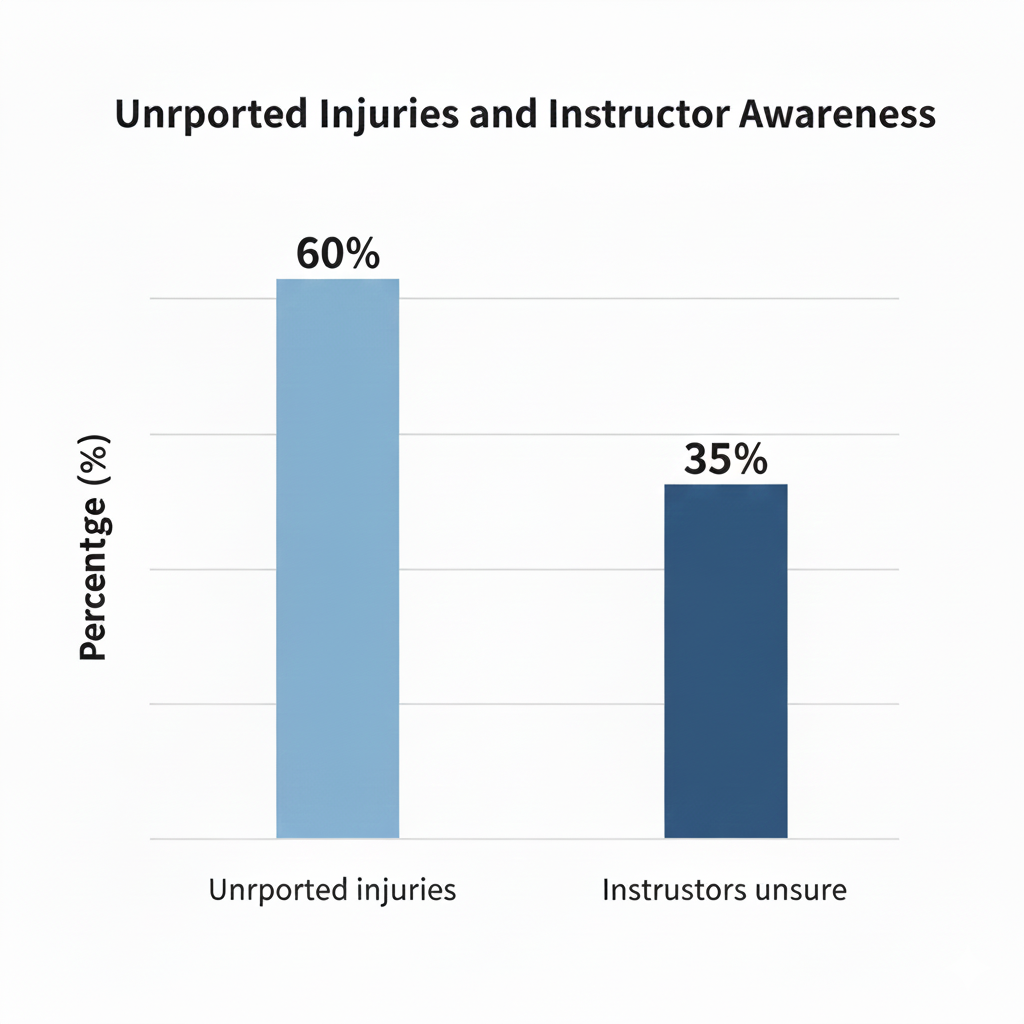
Even when students experience pain or injury, about 60% never tell their instructor.
As a result, around 35% of instructors say they don’t know whether injuries are happening in their own classes.
This graph visualises why many injuries never show up in studio statistics.
Note: Because injuries are so often unreported, any numbers based only on studio-side data are very likely to underestimate the true scale of the problem.
4. In practice, injuries trigger “breaks” and silent fade-outs
Injury may not be written on the cancellation form,
but it very often shows up as a break in practice.
Research tells us for example that:
About one-third of those who reported pain stopped practicing for three months or more
In a study of practitioners with hip problems, 71% had to interrupt their yoga practice
A three-month gap is enough to break almost any habit.
Once the rhythm is lost, many people never really return.
The story often looks like this:
subtle pain → pushing through → bigger pain → “I’ll rest a bit” → life gets busy → “maybe I’ll go back someday” → silent dropout

(This image is a conceptual illustration created for this article.)
5. Psychological dropout is just as important as physical injury
Injuries don’t only affect the body – they eat away at the mind as well.
Fear that “I might hurt myself again”
Frustration at not being able to keep up with the class
Loss of confidence – “maybe yoga just isn’t for me”
A subtle resistance to even going to the studio
For beginners in particular, these feelings can be enough to tip the scales toward quitting.
From the studio side, what you see is simple:
“They stopped coming.”
But behind that simple observation, there is often a chain of
small, unspoken injury experiences.
6. For seniors, the risk is even higher
For people aged 65 and older, the picture is more serious.
Population-level ER data from the US suggests that:
Yoga-related injury rates for seniors are about 58 per 100,000 people
For younger adults, the rate is under 10 per 100,000
In other words, the risk of a serious yoga injury among seniors is roughly six times higher than in younger age groups.
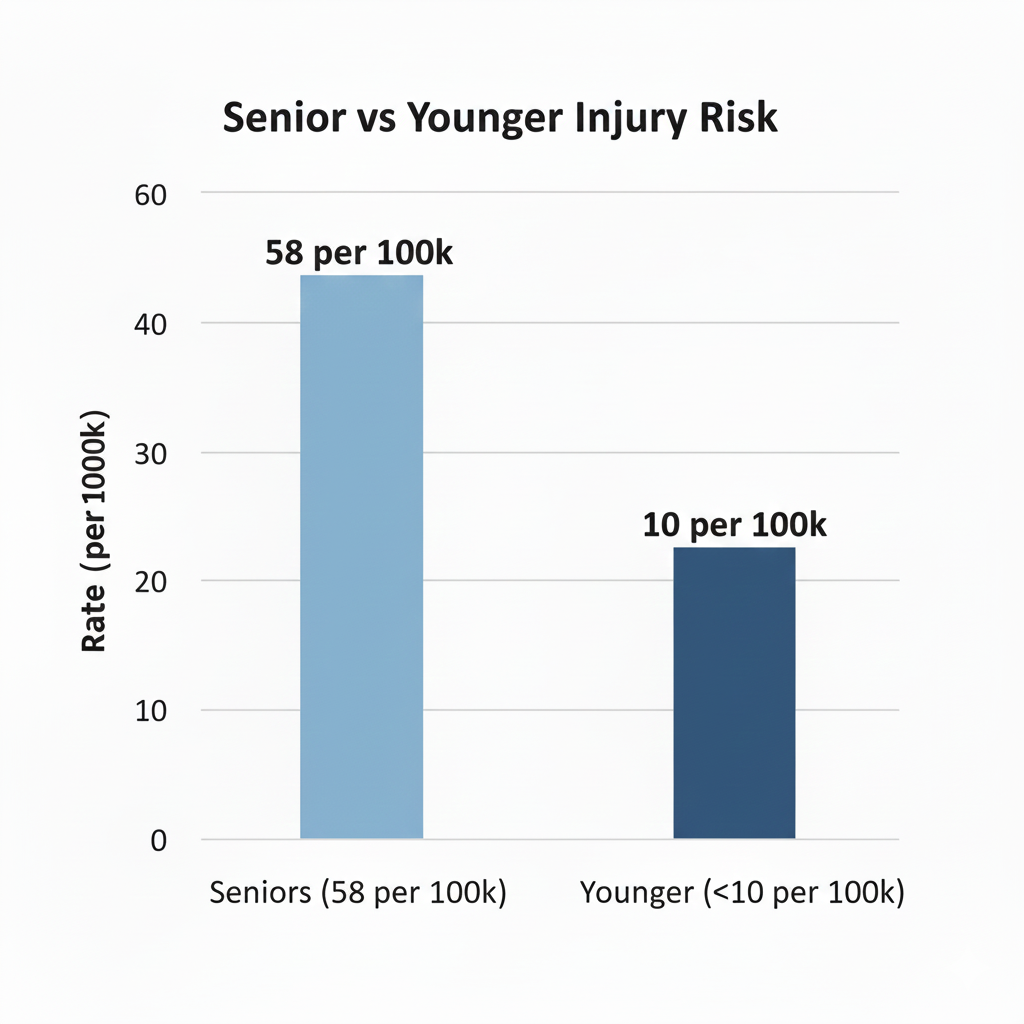
This graph compares estimated yoga injury rates between seniors (65+) and younger adults.
On a population scale the numbers (58 vs <10 per 100k) look small, but remember: this dataset only counts ER-level injuries.
If we included all minor and moderate injuries, the actual risk gap would be far larger.
Note: ER statistics only capture the tip of the iceberg – the most severe cases that end up in hospital.
Minor injuries and pain that still disrupt practice are not included here.
7. Conclusion – Injury is a “hidden dropout driver”
When we put everything together, the conclusion is clear:
Injuries and pain are common among yoga practitioners
Most injuries are under-reported or not reported at all
Many practitioners respond by taking a break
Breaks often turn into silent dropout
This is especially true for beginners and seniors
So:
Injury is not just a safety issue – it’s one of the biggest hidden reasons why people quietly stop doing yoga.
Because this mechanism is invisible to studios and instructors, the problem has been underestimated for a long time.
8. How yocto is approaching this problem
yoctoMat was developed as a product to make
“invisible load and misalignment” visible.
Centre of pressure and weight distribution
Left–right asymmetry
Hand and foot loading patterns
Subtle habits that are hard to see with the naked eye
By turning these into data in real time, we can:
Spot early warning signs of injury
Support instructors with objective information
Help students understand their own limits
Provide a safer environment for seniors and beginners
Reduce silent dropout caused by unrecognised injuries
Ultimately, our goal is simple:
To make it possible for more people to keep practicing yoga safely, for a long time.
yocto will continue to take this issue seriously and work with studios, instructors and researchers to address it.
Evidence & References
Pappas et al. (2017) – Prospective study of yoga-related injuries
New pain 10.7%, worsened pain 21% among yoga practitioners.
Matsushita & Oka (2015) – Adverse events associated with yoga classes in Japan
2,508 Japanese participants; 27–30% reported some post-class adverse event.
Under the Light Yoga School (2017) – Instructor injury survey
67.4% of instructors reported having experienced a yoga-related injury.
NEISS – National Electronic Injury Surveillance System
29,590 yoga-related ER visits over 14 years in the US.
Swain & McGwin (2016) – Yoga-related injuries in the United States
Senior injury rate 58 per 100k vs <10 per 100k in younger adults.
Mikkonen et al. (2016) – Injuries in Ashtanga yoga practitioners
62% of experienced Ashtanga practitioners reported injuries.
Inoue et al. – Orthopaedic perspectives on yoga-related spine and joint issues
Highlights the role of instruction quality and anatomical understanding in preventing injury.
https://www.jstage.jst.go.jp/article/jhpn/22/1/22_42/_article
Cramer et al. (2017) – “The Safety of Yoga: A Systematic Review”
Summarises the overall safety profile and typical patterns of yoga-related injuries.